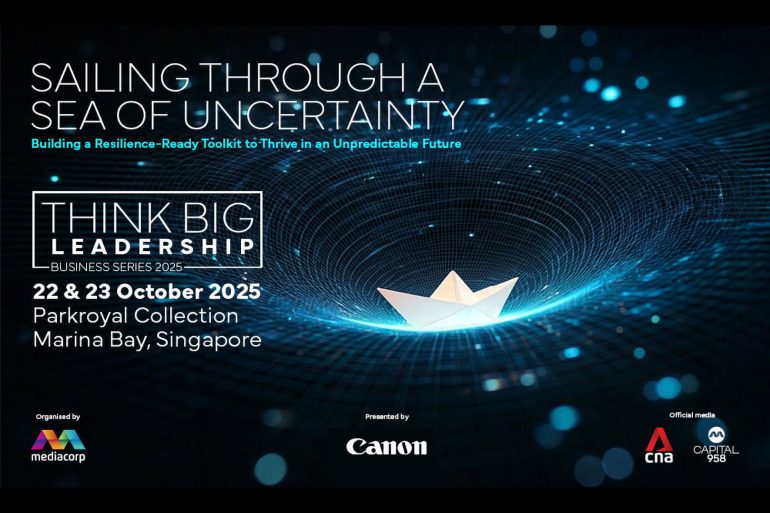
Canon Singapore’s Think Big Business Leadership Series 2025 drew more than 1,100 business leaders, policymakers, and entrepreneurs to trade notes on tariffs, talent, tech, and the tightrope of growth in a ever-changing world.
Set against renewed US tariff discussions and a shifting trade map, the series pressed leaders to look past the headlines and focus on playbooks that build shock absorbers into their operations. The Johor–Singapore Special Economic Zone (JS-SEZ) featured prominently, more than S$5.5 billion in fresh investments signalling a corridor that’s fast becoming Southeast Asia’s proving ground for advanced manufacturing, digital trade and cross-border logistics.
Guest-of-Honour Patrick Tay, Assistant Secretary-General of NTUC and MP for Pioneer SMC, cut through the noise with a blunt truth: “The only thing that is certain today is uncertainty. As we advance on our AI journey, we must ensure it creates meaningful impact, empowers all industries and remains inclusive for every worker to benefit and grow together.”
The Singapore Business Federation’s Musa Fazal pointed to the “silent and persistent threat” of global inflation, urging firms to use practical tools like SBF’s Trade AI Advisor and a ‘Navigating U.S. Tariffs’ playbook to plan ahead rather than firefight.
OCBC’s Xie Dongming argued the era of single-market efficiency is over; diversification across high-growth regional corridors is the new sanity. And Maybank’s Eddy Loh underlined the obvious that too many still dodge: AI adoption is no longer optional. Wait, and you won’t just fall behind, you’ll fall off.
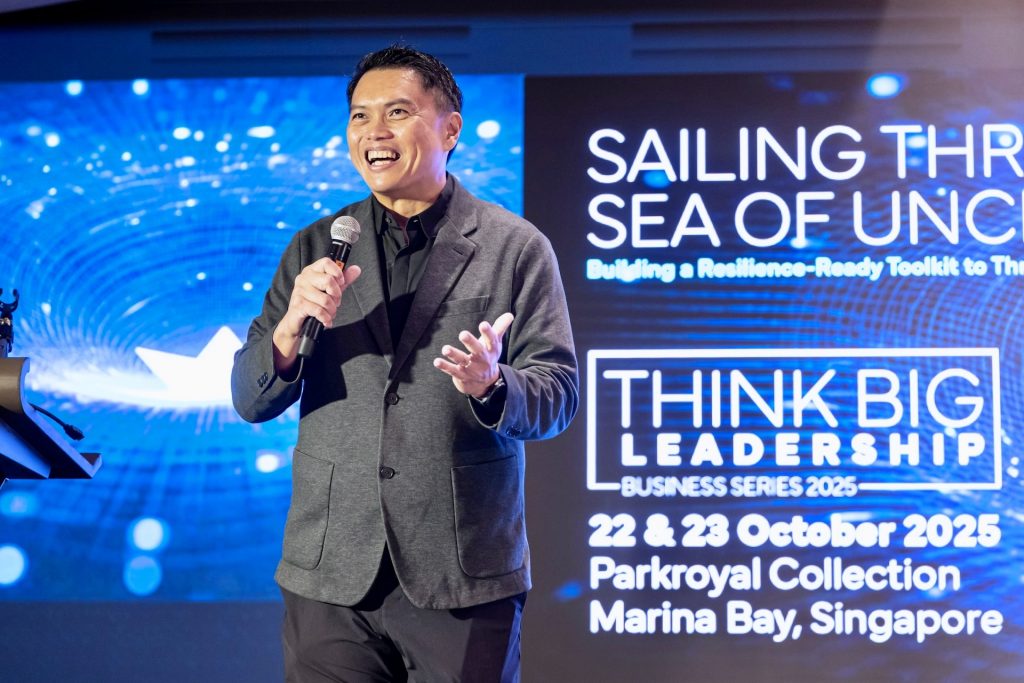
Academia weighed in with equal pragmatism. NUS Business School’s Dr Cai Daolu framed Asia as the engine of global growth, but cautioned that imbalances will persist, so policy “resets” won’t save anyone without organisational adaptability. NTU’s Prof Lam Kwok Yan reminded the room that AI and Big Data don’t just sharpen competitiveness; they redraw the threat landscape.
Which brings us to the human question: if AI is the defining technology of our time, what’s the defining responsibility of leaders? AI Singapore’s Laurence Liew offered a neat answer: redesign the division of labour. Let machines sprint through scenarios; let humans steer with judgment, ethics, and strategy.
For Canon Singapore, the company used the platform to unveil the imageFORCE C5100 series, positioned as a practical lever for productivity in an AI-shaped workplace. The launch tackled a local paradox head-on: while 82% of SMEs have adopted basic digital tools, only 4.2% have successfully implemented AI.
So, where does all this leave leaders steering into 2026?
With homework, certainly, but also with a clearer compass. Build regional depth, not just global breadth. Pair AI ambition with cybersecurity discipline. Invest in people as deliberately as you invest in platforms. And above all, treat uncertainty not as a storm to outlast, but as the climate to master.
Check out more news articles on Futr here!